“We’ve decided to keep humans in the loop.”
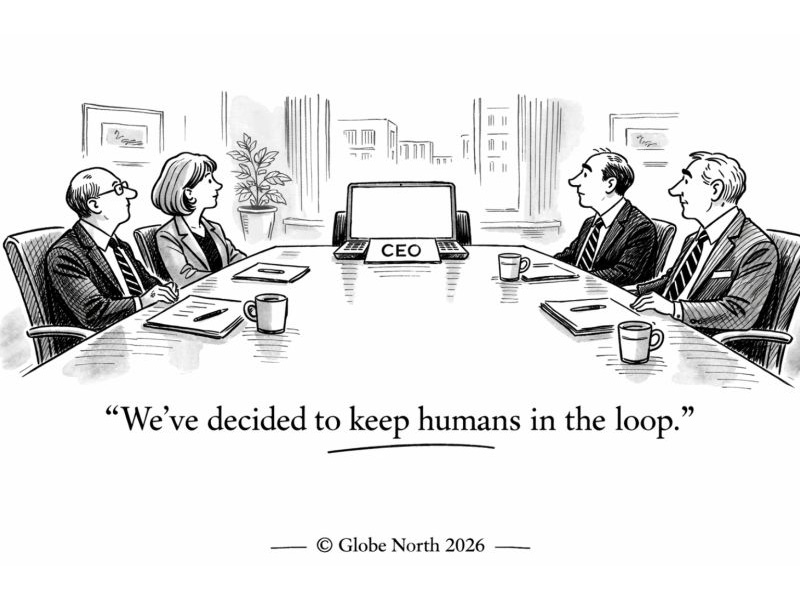 Funny? Maybe. Scary? Absolutely.
The boardroom. The laptop at the head of the table. The CEO placard. The announcement. Who decided? Not clear.
That’s the uncomfortable punchline.
We’re at a moment where AI capability is accelerating faster than most governance structures are adapting. Models are coding, analyzing, negotiating, drafting, optimizing — often better, faster, and cheaper than humans.
The risk isn’t that AI becomes evil.
The risk is that humans become passive.
When organizations move from:
👉 Human-led with AI support
to
👉 AI-led with human rubber stamps
…accountability starts to blur.
And blurred accountability is where strategy, ethics, and trust break down.
“Keeping humans in the loop” cannot mean ceremonial oversight.
It must mean:
🧭 Humans set direction
🚦 Humans define guardrails
🎯 Humans own outcomes
🧠 Humans remain capable — not complacent
AI should be a force multiplier, not a decision replacement engine.
The real questions over the next decade won’t be about model capability.
They will be about governance maturity.
If we don’t actively stay ahead of the capability curve, we won’t be leading the technology.
We’ll be rationalizing its decisions.