The AI Power Grid
The AI Power Grid
In our work advising CXOs on AI strategy, the key question on platform selection is rarely “What is the best model?” It’s almost always “What is the most promising AI in our environment?” It’s not just about capbility. It’s the operating system.
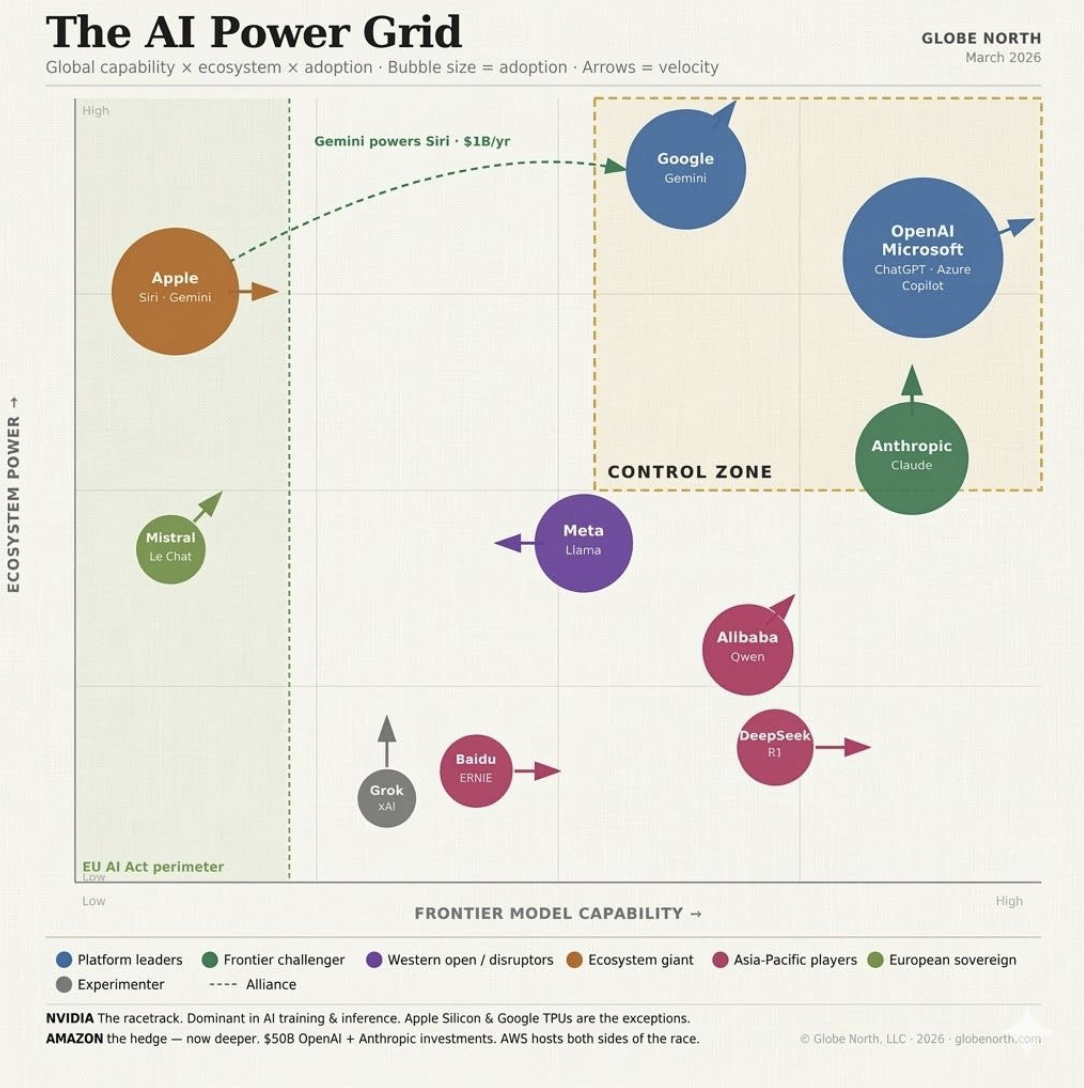
That’s why we created the AI Power Grid—a visual market analysis of the foundational model landscape, projected for March 2026. We don’t just map raw capability; we map frontier capabolity, ecosystem distribution and adoption velocity. And we view these dimensions through the lens of alliances – the teams forming to claim the high ground in the AI Wars.
4 Strategic Takeaways for Your 2026 AI Roadmap:
🛡️ 1. The ‘Control Zone’ Hegemony: The map defines a critical top-tier battleground. The OpenAI-Microsoft and Google titans have the ecosystem power and distribution that others are trying to close. For enterprises, your integration decisions and vendor lock-in risk are defined here.
🧠 2. The Symbiotic Alliance Play: Look closely at the Apple + Google connection. Apple, the ultimate ecosystem giant, is ‘outsourcing’ frontier capability ($1B/yr for Gemini) while maintaining control. This visual illustrates a vital playbook: you don’t always have to build the model; you have to manage the model safely and strategically. And it pays to own devices AND silicon.
🌏 3. Regional and Regulatory Acceleration: While the Control Zone is dominant in the West, note the rapid capability gains (high horizontal velocity) of Alibaba (Qwen), Baidu (ERNIE), and DeepSeek. This creates fragmented data residency and trust challenges. For European firms, navigating the ‘EU AI Act perimeter’ for models like Mistral is a strategic bottleneck and a compliant moat.
🚧 4. The Infrastructure Play is the Ultimate Hedge: Notice the footnote. NVIDIA is the racetrack, but Amazon is the ultimate hedge. With $50B invested across OpenAI and Anthropic, AWS is effectively hosting both sides of the race. This infrastructure-level play is often a board’s blind spot for long-term spend and supply-chain risk.
The Agentic Strategy Shift:
This isn’t just a map of model intelligence. It’s a visualization of the emerging autonomous workforce. The complexity of these nested alliances means you are no longer just licensing a tool; you are inheriting the actionable authority of your partner’s ecosystem.
The Security and Trust Angle:
This is also a visualization of your extended trust perimeter. The complexity of these nested alliances—like the Apple-Gemini connection—means you are now inheriting the security posture of your partner’s partners. We must align security architecture with the velocity of AI adoption mapped here.
What’s your take on the AI landscape? How will the movements of the key players impact your stategy/investment roadmap? Let’s discuss.
👉 Read the full analysis in our latest brief: https://lnkd.in/eUhJHMFe